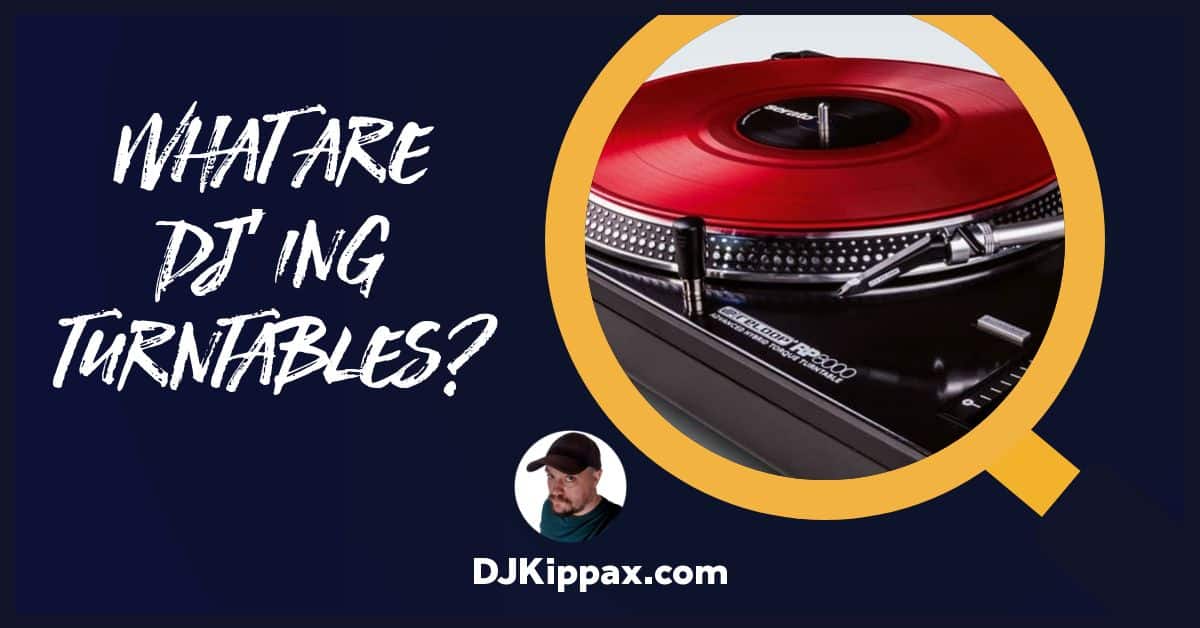
In recent years there’s been a revival in vinyl sales, resulting in more DJ’s choosing to spin the black discs. So, it should come as no surprise to find that DJ equipment manufacturers are now selling turntables again.
Also, the widespread use of DJ’ing programmes, like Serato and Traktor, has accelerated the use of DJ’ing turntables even further. These vinyl emulation programmes allow the DJ to manipulate music files in the same manner as turntable. The result is, you can have the hands-on feel of vinyl whilst still being able to use the advanced features you get with digital DJ’ing. Thus, allowing the DJ to create some very innovate sets and mixes.
Additionally, many DJing equipment manufacturers now have new lines of turntables. Although as well take a looking later in this article there some caveats about this.
Recently, Technics announced they’re making turntables again, and they’ve released some new models
As you can see, being a vinyl DJ isn’t a rare thing these days. It seems this style of DJ’ing is going to be with us for some time yet.
So, let’s look at what makes a DJing turntable.
Table of Contents
The basic components of a DJ’ing deck
Direct-drive and belt drive
All turntables use motors to rotate their platters. But most turntables power their platters in two distinct ways: direct-drive and belt drive.
With direct-drive turntables, the motor and bearing are located directly under the platter. The motor is connected straight to the platter. This direct connection results in higher degree of responsiveness, control and torque in the platter.
Belt drive turntables use a belt to connect the motor and platter. The platter bearing is located beneath the platter and not above the motor. The motor is often offset and housed at the side of the turntable.
The downside of a belt-driven turntable is that they have lower torque and more platter speed fluctuations. This makes them much more difficult to DJ with. The very first turntables I bought were belt drives, and it was hard to get your beats matched and to keep them matched.
Any turntable motor will naturally produce noise and vibration when used. Belts are good for absorbing vibration. So, by connecting the motor via a belt the platter is isolated, and this results in less noise being transmitted to the tonearm.
Expensive belt drives turntables will usually produce better sound. Also, belt drive decks are cheaper to make and easier to construct. Therefore, the design is favoured by hi-fi turntable manufacturers. Most hi-fi style turntables are powered via belt drive.
It’s rare to find DJing turntable which is powered via belt drive these days. Back when I started to DJ in the mid-90s they were more common.
To conclude: DJ turntables sacrifice a degree of sound quality (by not using belts) to enable them to have higher torque and speed consistency. These features are essential for DJing because they allow the DJ to beatmatch, scratch, and mix tunes more easily. Expensive belt drive decks sound better, but are a poor choice for DJ’ing with.
Tonearm
A tonearm is a movable part which carries the pickup and allows the stylus to follow the record groove.
Inside the tonearm will find wiring which is fed into the body of the turntable directly through the arm.
Additionally, the tonearm has a weight at the back. This allows you to correctly balance the needle and add extra weight for improved tracking.
Some DJ deck tonearms have a feature called anti-skating. This is designed to stop your needle skating across the record. However, this is usually only found on S-shaped tonearms.
Many DJing turntables also come with height adjustment which alters the elevation and angle of the tonearm in relation to the record and platter.
Tonearms come in two distinct shapes: S-bend tonearms and straight. S-bend tonearms have a slightly improved sound quality, but they don’t track the record as well. S-bend tonearms are a more traditional design. You can see this shape tonearm on decks like the Technics 1200.
Straight tonearms sacrifice some sound quality for stability. Straight tonearms are a better choice for DJ’s especially those who are into scratching. And if you are planning to DJ with timecodes and a programme like Serato or Traktor, the sound quality doesn’t matter.
When buying a turntable, you need to thoroughly check tonearm. Ensure that it moves around freely, and it doesn’t wobble, catch, or bind. Any play in the tonearm will reduce its tracking capabilities and make it prone to jumping. Tonearms can be one of the most expensive things to fix on any turntable. So, if you are buying a used turntable, and you find it has a bad tonearm, this can be enough of a reason not to buy.
Anti-skate
Any turntable which has an S-shaped tonearm should come with anti-skate. The anti-skate dial usually can be found at the side of the tonearm.
A correctly balanced S-shape tonearm should naturally want to pull in towards the centre of the turntable (unless it’s been damaged). Anti-skating controls this pull to the centre. And it reduces the speed in which tonearm will skate towards the middle of the deck. This is a very useful feature to use if you are planning to scratch.
Pitch control
The pitch control alters the speed of the platter. You will use control when trying to match the tempos of your records.
The pitch control is usually found at the side of the turntable top. It usually looks like a long fader.
Turntable pitch control varies in range. Technics 1210s turntables could be pitched +-8%. Whereas decks like the Vestax PDX range could be pitched to +-50%.
8% pitch is more than enough for most DJs. The extra pitch is handy for scratch DJs and turntablist because it allows more creative techniques.
Platter
This is the large (usually) aluminium or steel disc which sits in the middle of the turntable. It’s the rotating disc you place our record on.
Some platters have dots on the side which are used for the quartz lock. The quartz lock is a strobing effect which some turntables use to help calibrate their speed. When the deck is running at 0% pitch the dots should appear to be still and they should not move. Not all turntables have a have quartz lock.
When buying a second-hand turntable always make sure the platter spin smoothly and that’s not catching on anything. Also, be sure to spin the platter both ways when inspecting the deck.
Cables
All turntables will have some way of connecting them to a mixer or preamp. Newer turntables may even have a USB out which allow them to be directly connected to a laptop.
Most turntables will come with a ground cable too. The ground cable tends to be a thinner wire with and a spade style connector on the end. DJ turntables are usually grounded by connecting them to the ground plug on the back of a DJ mixer. Although some DJ’ing type soundcards now come with ground connections built into them.
A working ground is critical if you want good sound from a turntable. A bad ground will cause a buzzing sound which can be heard over the deck output. You will also be able to hear any bad humming ground via the mixer.
A bad ground can make DJ’ing with timecodes impossible. Programmes like Serato or Traktor cannot track the timecode if your ground doesn’t work. Bear this in mind if you are planning to use these programmes with turntables when playing live. Many clubs don’t service or maintain their turntables, and they might not be aware their ground connections are broken. Have a backup plan for this situation because it will happen to you sooner or later.
Other turntable features
Many modern OEM turntables come with additional features. These vary from turntable to turntable. Some turntable may include things like keylock, jog controls and stop/start brake adjustments.
Don’t buy a DJ turntable solely on the number of features alone. Because not all these features are useful; it depends on the type of DJ you are.
Also, the reliability of these extra features can sometimes be questionable. And some turntable manufacturers just add these extras to increase sales.
If you are planning to buy a turntable with lots of features and extras, be sure to find some honest reviews on your model. Reddit, DJ forums, YouTube (and YouTube comments), and Amazon.com are great places to find this info.
SuperOEMS
One thing to be aware of when buying any modern DJ turntable is the majority are made by one Chinese company and are resold under different brands names.
Hanpin makes many turntables being sold by the big DJ’ing brands such as Pioneer, Stanton, Dennon, etc.
Basically, the big brands buy the Hanpin base turntable – add tweaks, cosmetics and their branding to the design – and then sell them at an inflated price.
It doesn’t matter if you are buying a Pioneer or a Stanton turntable – you are getting the same components. And they’re all made in the same factory in China.
Where can I buy a DJ turntable?
You can buy new turntables from many online shops and DJ equipment retailers. But I highly recommend that you consider buying a pair of second-hand turntables – you will save money.
As I mentioned previously, most new turntables are just OEM clones. But many OEM models are well made and reliable. So, it’s easy to find a used pair of decks for sale which are in good working order.
Ideally, if you are going to buy a set of used turntables try to view them in person. This will allow you to physically check to see if the decks are working.
Aside from this, eBay, Amazon, Craigslist (Gumtree for those in the UK), and various Facebook groups, are good places for hunting down used turntables for sale. The downside of buying without seeing is that you can’t physically check them. You can only rely on the seller’s verdict that the deck is in working order.
Alternatively, you still can’t go wrong with buying a pair of Technics 1200s. Technics decks are built like tanks. Even 25-30-year-old Technics are still usable today. Also, it’s easy to find people who can service these decks.
Technics might not have the fancy features of their modern OEM counterparts. And the S-shaped arm makes it harder to scratch on. But they still the industry standard for club installations.
There’s something to be said about getting used to the imperfections which Technics decks have. Because you can translate more of your DJing techniques to club systems when playing live.
The bad thing about Technics is that they’re now collector items. Thus, the second-hand value of these decks has gone up significantly over the last 15 years. Not only do many new DJ still want to learn using these decks, but you can turn the Technics into a formidable audiophile hi-fi deck. Many people want these decks. Therefore, the resale value of Technics decks is high – if they are in good working condition.
What type of stylus should I buy for DJ’ing with turntables?
The type of stylus you choose depends on what type of DJ are. The main determining factor is whether you’re doing to scratch or just mix records.
If you’re planning to just mix records, you have far more choice when it comes to turntable cartridges and needles. Again, just hunt around sites like Reddit and the DJ forums to find what’s popular and reliable.
For scratch DJ’s your options are limited. There’s never been so little choice when it comes to reliable needles for scratching.
The Shure M44-7 is regarded as being the best needles for scratch DJs and turntablists. However, Shure no longer make these or any other DJ’ing type stylus and carts.
Subsequently, the price for original Shure M44-7s has now gone up. You will pay a premium if you buy these cartridges as they’re now collector items. Also, it’s hard to source quality needles for them because many sold by stores are Chinese counterfeits – and these vary in quality.
If you are a scratch DJ, I would recommend Ortofon concords Q-Berts because you can get parts and styluses easily.
How to set up a turntable and mixer
Setting up DJ and turntables is simple. If you’re just using vinyl you simply plug your turntable into the phono inputs on your DJ mixer, and hook up the ground connections.
If you’re using vinyl emulation timecodes (with software such as Traktor or Serato) the setup is a little different. You need to route your decks into an external soundcard (made by the timecode manufacturer), and then route the output of the soundcard into the mixer. The output routing of the soundcard varies depending on which software program you are using. But both manufacturers timecode outputs are CD-level volumes, therefore they want to go through the CD lines on your DJ mixer.
Some DJ mixers come with Serato or Traktor compatible soundcards built in. The input and output routing will be a tad different from these mixers. You’ll just need to check the mixer instructions to see how you wire them up correctly.
Moving from digital DJ’ing to turntables. What to expect
If you’re moving from being the digital DJ to turntables here’s what to expect. DJ’ing with turntables is harder but can be more rewarding.
With a pure ‘vinyl only’ setup you have no BPM counters, phase metres, BPM grids or jog buttons. You must queue and match your BPM is by ear. It will take quite a bit of practice to get your head around manually matching BPMs if you’ve never done it before.
No turntable has perfect speed lock. The platter speed fluctuates wildly when compared with digital DJ’ing product. These speed fluctuations are technically referred to as WOW and flutter.
So, even after matching your tempo, your beatmatching can drift out of time when mixing. You will often have to make minor pitch corrections when mixing to keep your beat-matched. But this is part of the challenge of using turntables to mix.
Things do get easier when using timecodes because they bring the functionality of digital DJing into the setup. When DJ’ing with vinyl timecodes you can use features like jog controls, BPM counters, and even BPM sync button, to quickly match or correct your tempos. How many of these features you use is entirely your own choice.
For scratching, turntables are still the best choice. They provide the best platform for tricks, techniques and creativity.
Also, there are some innovative turntable designs out there like the Stanton S7000 MkII. These come with inbuilt cue buttons which add many creative possibilities for scratching techniques. And older decks like the Vestax Controller One which really pushed the boundaries of scratch turntable design (good luck trying to find one these).
What turntable should I buy?
The biggest factors when choosing turntables are budget and your intentions.
If you’re just a pair of decks for your room and house I wouldn’t worry too much about buying an OEM variant.
However, if you want to DJ in clubs, or you plan to use your decks at a club night, you’ll need something more expensive. Possibly, a Super OEM turntable or even Technics.
Cheap decks often don’t perform well in a club as they can be prone to feedback. If your decks are poor at handling feedback you will never be able to play them loud. And this can matter in a club or at a live event.
Most Super OEM decks – like the Stanton Str8-150 – are more than capable at minimising feedback loops when used in loud environments. But the downside of super OEMs is that many DJ won’t like using them. Primarily they’ll have an issue with the pitch and extra torque when compared with the de-facto club deck – you guessed it – the Technics 1200.
So, if you’re hoping to play live one day, or you plan to use your decks at club night and live events, consider Technics decks. Yes, they are slightly inferior to modern OEMs, but they have a proven design, and other DJ’s will be happy using them.
Also, if you get used to the imperfections of Technics, you’ll have a better chance of transferring more of your skills when playing live.
Takeaways
- Learning to DJ on turntables is the hardest way to learn the craft.
- DJ with turntables is expensive. Not only do you have to buy turntables to start, but you may even have to start buying vinyl.
- You can reduce your vinyl DJ’ing costs by using timecodes and a programme like Traktor or Serato. Because this will allow you to DJ with digital files.
- Most new turntables are made by one Chinese manufacturer. The big DJ’ing brands buy these turntables, alter them slightly, and then sell them at a premium. But essentially, many of the turntable models by the big brands share the same main components.
- You can save money by buying second-hand OEM turntables or old Technics decks.
- Technics decks are still worth buying as long they are in good working order.
- When buying a used deck pay attention to the tonearm. It’s the costliest and hardest thing to fix.
- Learning to DJ with Technics means you can transfer your skills more easily to clubs, gigs, and live venues.
- Technics aren’t the best decks to mix and scratch on. Many super OEMs are better, but these aren’t used in clubs.
- Turntables are more fun to use, but most digital DJ’ing methods are more practical
- You can own more than one pair of turntables.
